 Preshing on Programming
Generally speaking, in lock-free programming, there are two ways in which threads can manipulate shared memory: They can compete with each other for a resource, or they can pass information co-operatively from one thread to another. Acquire and release semantics are crucial for the latter: reliable passing of information between threads. In fact, I would venture to guess that incorrect or missing acquire and release semantics is the #1 type of lock-free programming error.
In this post, I’ll demonstrate various ways to achieve acquire and release semantics in C++. I’ll touch upon the C++11 atomic library standard in an introductory way, so you don’t already need to know it. And to be clear from the start, the information here pertains to lock-free programming without sequential consistency. We’re dealing directly with memory ordering in a multicore or multiprocessor environment.
Unfortunately, the terms acquire and release semantics appear to be in even worse shape than the term lock-free, in that the more you scour the web, the more seemingly contradictory definitions you’ll find. Bruce Dawson offers a couple of good definitions (credited to Herb Sutter) about halfway through this white paper. I’d like to offer a couple of definitions of my own, staying close to the principles behind C++11 atomics:
Acquire semantics is a property that can only apply to operations that read from shared memory, whether they are read-modify-write operations or plain loads. The operation is then considered a read-acquire. Acquire semantics prevent memory reordering of the read-acquire with any read or write operation that follows it in program order.
Release semantics is a property that can only apply to operations that write to shared memory, whether they are read-modify-write operations or plain stores. The operation is then considered a write-release. Release semantics prevent memory reordering of the write-release with any read or write operation that precedes it in program order.
Once you digest the above definitions, it’s not hard to see that acquire and release semantics can be achieved using simple combinations of the memory barrier types I described at length in my previous post. The barriers must (somehow) be placed after the read-acquire operation, but before the write-release. [Update: Please note that these barriers are technically more strict than what’s required for acquire and release semantics on a single memory operation, but they do achieve the desired effect.]
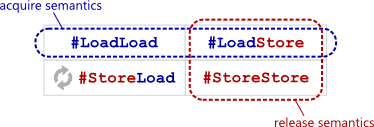
What’s cool is that neither acquire nor release semantics requires the use of a #StoreLoad barrier, which is often a more expensive memory barrier type. For example, on PowerPC, the lwsync (short for “lightweight sync”) instruction acts as all three #LoadLoad, #LoadStore and #StoreStore barriers at the same time, yet is less expensive than the sync instruction, which includes a #StoreLoad barrier.
With Explicit Platform-Specific Fence Instructions
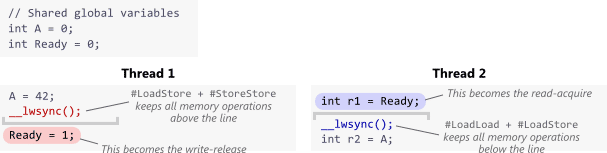
One way to obtain the desired memory barriers is by issuing explicit fence instructions. Let’s start with a simple example. Suppose we’re coding for PowerPC, and __lwsync() is a compiler intrinsic function that emits the lwsync instruction. Since lwsync provides so many barrier types, we can use it in the following code to establish either acquire or release semantics as needed. In Thread 1, the store to Ready turns into a write-release, and in Thread 2, the load from Ready becomes a read-acquire.
 If we let both threads run and find that
 r1 == 1, that serves as confirmation that the value of A assigned in Thread 1 was passed successfully to Thread 2. As such, we are guaranteed that r2 == 42. In my previous post, I already gave a lengthy analogy for #LoadLoad and #StoreStore to illustrate how this works, so I won’t rehash that explanation here.
In formal terms, we say that the store to Ready synchronized-with the load. I’ve written a separate post about synchronizes-with here. For now, suffice to say that for this technique to work in general, the acquire and release semantics must apply to the same variable – in this case, Ready – and both the load and store must be atomic operations. Here, Ready is a simple aligned int, so the operations are already atomic on PowerPC.
With Fences in Portable C++11
The above example is compiler- and processor-specific. One approach for supporting multiple platforms is to convert the code to C++11. All C++11 identifiers exist in the std namespace, so to keep the following examples brief, let’s assume the statement using namespace std; was placed somewhere earlier in the code.
C++11’s atomic library standard defines a portable function atomic_thread_fence() that takes a single argument to specify the type of fence. There are several possible values for this argument, but the values we’re most interested in here are memory_order_acquire and memory_order_release. We’ll use this function in place of __lwsync().
There’s one more change to make before this example is complete. On PowerPC, we knew that both operations on Ready were atomic, but we can’t make that assumption about every platform. To ensure atomicity on all platforms, we’ll change the type of Ready from int to atomic<int>. I know, it’s kind of a silly change, considering that aligned loads and stores of int are already atomic on every modern CPU that exists today. I’ll write more about this in the post on synchronizes-with, but for now, let’s do it for the warm fuzzy feeling of 100% correctness in theory. No changes to A are necessary.
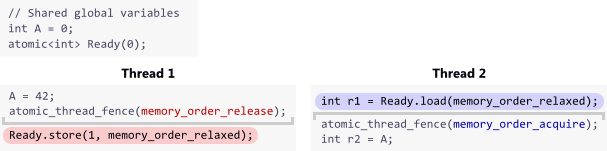
The memory_order_relaxed arguments above mean “ensure these operations are atomic, but don’t impose any ordering constraints/memory barriers that aren’t already there.”
Once again, both of the above atomic_thread_fence() calls can be (and hopefully are) implemented as lwsync on PowerPC. Similarly, they could both emit a dmb instruction on ARM, which I believe is at least as effective as PowerPC’s lwsync. On x86/64, both atomic_thread_fence() calls can simply be implemented as compiler barriers, since usually, every load on x86/64 already implies acquire semantics and every store implies release semantics. This is why x86/64 is often said to be strongly ordered.
Without Fences in Portable C++11
In C++11, it’s possible to achieve acquire and release semantics on Ready without issuing explicit fence instructions. You just need to specify memory ordering constraints directly on the operations on Ready:

Think of it as rolling each fence instruction into the operations on Ready themselves. [Update: Please note that this form is not exactly the same as the version using standalone fences; technically, it’s less strict.] The compiler will emit any instructions necessary to obtain the required barrier effects. In particular, on Itanium, each operation can be easily implemented as a single instruction: ld.acq and st.rel. Just as before, r1 == 1 indicates a synchronizes-with relationship, serving as confirmation that r2 == 42.
This is actually the preferred way to express acquire and release semantics in C++11. In fact, the atomic_thread_fence() function used in the previous example was added relatively late in the creation of the standard.
Acquire and Release While Locking
As you can see, none of the examples in this post took advantage of the #LoadStore barriers provided by acquire and release semantics. Really, only the #LoadLoad and #StoreStore parts were necessary. That’s just because in this post, I chose a simple example to let us focus on API and syntax.
One case in which the #LoadStore part becomes essential is when using acquire and release semantics to implement a (mutex) lock. In fact, this is where the names come from: acquiring a lock implies acquire semantics, while releasing a lock implies release semantics! All the memory operations in between are contained inside a nice little barrier sandwich, preventing any undesireable memory reordering across the boundaries.
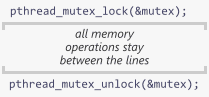
Here, acquire and release semantics ensure that all modifications made while holding the lock will propagate fully to the next thread that obtains the lock. Every implementation of a lock, even one you roll on your own, should provide these guarantees. Again, it’s all about passing information reliably between threads, especially in a multicore or multiprocessor environment.
In a followup post, I’ll show a working demonstration of C++11 code, running on real hardware, which can be plainly observed to break if acquire and release semantics are not used.