Memory Reordering Caught in the Act

May 15, 2012

When writing lock-free code in C or C++, one must often take special care to enforce correct memory ordering. Otherwise, surprising things can happen.

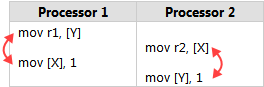
Intel lists several such surprises in Volume 3, Section 8.2.3 of their x86/64 Architecture Specification. Here’s one of the simplest examples. Suppose you have two integers X and Y somewhere in memory, both initially 0. Two processors, running in parallel, execute the following machine code:

Don’t be thrown off by the use of assembly language in this example. It’s really the best way to illustrate CPU ordering. Each processor stores 1 into one of the integer variables, then loads the other integer into a register. (r1 and r2 are just placeholder names for actual x86 registers, such as eax.)

Now, no matter which processor writes 1 to memory first, it’s natural to expect the other processor to read that value back, which means we should end up with either r1 = 1, r2 = 1, or perhaps both. But according to Intel’s specification, that won’t necessarily be the case. The specification says it’s legal for both r1 and r2 to equal 0 at the end of this example — a counterintuitive result, to say the least!

One way to understand this is that Intel x86/64 processors, like most processor families, are allowed to reorder the memory interactions of machine instructions according to certain rules, as long it never changes the execution of a single-threaded program. In particular, each processor is allowed to delay the effect of a store past any load from a different location. As a result, it might end up as though the instructions had executed in this order:
Let’s Make It Happen

It’s all well and good to be told this kind of thing might happen, but there’s nothing like seeing it with your own eyes. That’s why I’ve written a small sample program to show this type of reordering actually happening. You can download the source code here.

The sample comes in both a Win32 version and a POSIX version. It spawns two worker threads which repeat the above transaction indefinitely, while the main thread synchronizes their work and checks each result.

Here’s the source code for the first worker thread. X, Y, r1 and r2 are all globals, and POSIX semaphores are used to co-ordinate the beginning and end of each loop.

sem_t beginSema1;
sem_t endSema;

int X, Y;
int r1, r2;

void *thread1Func(void *param)
{
    MersenneTwister random(1);                // Initialize random number generator
    for (;;)                                  // Loop indefinitely
    {
        sem_wait(&beginSema1);                // Wait for signal from main thread
        while (random.integer() % 8 != 0) {}  // Add a short, random delay

        // ----- THE TRANSACTION! -----
        X = 1;
        asm volatile("" ::: "memory");        // Prevent compiler reordering
        r1 = Y;

        sem_post(&endSema);                   // Notify transaction complete
    }
    return NULL;  // Never returns
};

A short, random delay is added before each transaction in order to stagger the timing of the thread. Remember, there are two worker threads, and we’re trying to get their instructions to overlap. The random delay is achieved using the same MersenneTwister implementation I’ve used in previous posts, such as when measuring lock contention and when validating that the recursive Benaphore worked.

Don’t be spooked by the presence of the asm volatile line in the above code listing. This is just a directive telling the GCC compiler not to rearrange the store and the load when generating machine code, just in case it starts to get any funny ideas during optimization. We can verify this by checking the assembly code listing, as seen below. As expected, the store and the load occur in the desired order. The instruction after that writes the resulting register eax back to the global variable r1.

$ gcc -O2 -c -S -masm=intel ordering.cpp
$ cat ordering.s
	...
	mov	DWORD PTR _X, 1
	mov	eax, DWORD PTR _Y
	mov	DWORD PTR _r1, eax
	...

The main thread source code is shown below. It performs all the administrative work. After initialization, it loops indefinitely, resetting X and Y back to 0 before kicking off the worker threads on each iteration.

Pay particular attention to the way all writes to shared memory occur before sem_post, and all reads from shared memory occur after sem_wait. The same rules are followed in the worker threads when communicating with the main thread. Semaphores give us acquire and release semantics on every platform. That means we are guaranteed that the initial values of X = 0 and Y = 0 will propogate completely to the worker threads, and that the resulting values of r1 and r2 will propogate fully back here. In other words, the semaphores prevent memory reordering issues in the framework, allowing us to focus entirely on the experiment itself!

int main()
{
    // Initialize the semaphores
    sem_init(&beginSema1, 0, 0);
    sem_init(&beginSema2, 0, 0);
    sem_init(&endSema, 0, 0);

    // Spawn the threads
    pthread_t thread1, thread2;
    pthread_create(&thread1, NULL, thread1Func, NULL);
    pthread_create(&thread2, NULL, thread2Func, NULL);

    // Repeat the experiment ad infinitum
    int detected = 0;
    for (int iterations = 1; ; iterations++)
    {
        // Reset X and Y
        X = 0;
        Y = 0;
        // Signal both threads
        sem_post(&beginSema1);
        sem_post(&beginSema2);
        // Wait for both threads
        sem_wait(&endSema);
        sem_wait(&endSema);
        // Check if there was a simultaneous reorder
        if (r1 == 0 && r2 == 0)
        {
            detected++;
            printf("%d reorders detected after %d iterations\n", detected, iterations);
        }
    }
    return 0;  // Never returns
}

Finally, the moment of truth. Here’s some sample output while running in Cygwin on an Intel Xeon W3520.
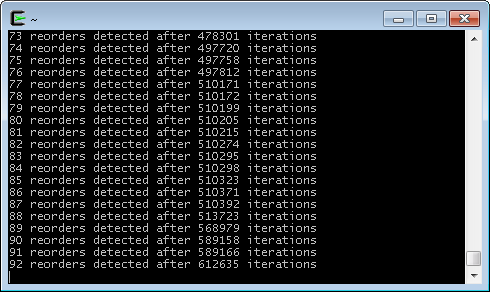
And there you have it! During this run, a memory reordering was detected approximately once every 6600 iterations. When I tested in Ubuntu on a Core 2 Duo E6300, the occurrences were even more rare. One begins to appreciate how subtle timing bugs can creep undetected into lock-free code.

Now, suppose you wanted to eliminate those reorderings. There are at least two ways to do it. One way is to set thread affinities so that both worker threads run exclusively on the same CPU core. There’s no portable way to set affinities with Pthreads, but on Linux it can be accomplished as follows:

    cpu_set_t cpus;
    CPU_ZERO(&cpus);
    CPU_SET(0, &cpus);
    pthread_setaffinity_np(thread1, sizeof(cpu_set_t), &cpus);
    pthread_setaffinity_np(thread2, sizeof(cpu_set_t), &cpus);

After this change, the reordering disappears. That’s because a single processor never sees its own operations out of order, even when threads are pre-empted and rescheduled at arbitrary times. Of course, by locking both threads to a single core, we’ve left the other cores unused.

On a related note, I compiled and ran this sample on Playstation 3, and no memory reordering was detected. This suggests (but doesn’t confirm) that the two hardware threads inside the PPU may effectively act as a single processor, with very fine-grained hardware scheduling.

Preventing It With a StoreLoad Barrier

Another way to prevent memory reordering in this sample is to introduce a CPU barrier between the two instructions. Here, we’d like to prevent the effective reordering of a store followed by a load. In common barrier parlance, we need a StoreLoad barrier.

On x86/64 processors, there is no specific instruction which acts only as a StoreLoad barrier, but there are several instructions which do that and more. The mfence instruction is a full memory barrier, which prevents memory reordering of any kind. In GCC, it can be implemented as follows:

    for (;;)                                  // Loop indefinitely
    {
        sem_wait(&beginSema1);                // Wait for signal from main thread
        while (random.integer() % 8 != 0) {}  // Add a short, random delay

        // ----- THE TRANSACTION! -----
        X = 1;
        asm volatile("mfence" ::: "memory");  // Prevent memory reordering
        r1 = Y;

        sem_post(&endSema);                   // Notify transaction complete
    }

Again, you can verify its presence by looking at the assembly code listing.

	...
	mov	DWORD PTR _X, 1
	mfence
	mov	eax, DWORD PTR _Y
	mov	DWORD PTR _r1, eax
	...

With this modification, the memory reordering disappears, and we’ve still allowed both threads to run on separate CPU cores.

Similar Instructions and Different Platforms

Interestingly, mfence isn’t the only instruction which acts as a full memory barrier on x86/64. On these processors, any locked instruction, such as xchg, also acts as a full memory barrier — provided you don’t use SSE instructions or write-combined memory, which this sample doesn’t. In fact, the Microsoft C++ compiler generates xchg when you use the MemoryBarrier intrinsic, at least in Visual Studio 2008.

The mfence instruction is specific to x86/64. If you want to make the code more portable, you could wrap this intrinsic in a preprocessor macro. The Linux kernel has wrapped it in a macro named smp_mb, along with related macros such as smp_rmb and smp_wmb, and provided alternate implementations on different architectures. For example, on PowerPC, smp_mb is implemented as sync.

All these different CPU families, each having unique instructions to enforce memory ordering, with each compiler exposing them through different instrincs, and each cross-platform project implementing its own portability layer… none of this helps simplify lock-free programming! This is partially why the C++11 atomic library standard was recently introduced. It’s an attempt to standardize things, and make it easier to write portable lock-free code.

25 Comments

  • Reply Matt Diesel on May 15, 2012

    I’m very interested to learn what it is that makes only 1/6600 iterations use this. Surely if there is a benefit to switching the instructions, it should be done so predictably?

    Most things like the pipeline act in a predictable fashion, which we can learn, and use.

    • Reply Drew Amato on May 15, 2012

      I’m not the author (and I’m only pretending to understand all this) but I assume the unpredictability in the results is due to the need for special timing conditions to occur (even when the instruction order is consistently switched): the two calls need to overlap, the two reads need to happen before the two writes.

    • Reply Jeff Preshing on May 15, 2012

      The main reason reordering is detected so rarely in this sample is because the semaphore timing is unpredictable and I introduced randomness to compensate. You could probably detect reordering much more frequently if you use a different synchronization method in the worker threads; for example, busy-waiting on a flag. I chose not to do this in the sample because then, I’d need to ensure correct memory ordering around the flag, and that would draw attention away from the place where I really wanted to demonstrate reordering.

      Also, as Bruce Dawson points out below, memory reordering is not necessarily an artifact of CPU instructions being switched. Memory reordering tends to be more the result of the way CPU caches work: If you are really interested in those details, I’d recommend Appendix C of Is Parallel Programming Hard.

  • Reply David Brown on May 15, 2012

    Good article. One minor nit, the gcc Makefile should have the ordering.cpp filename after the colon, not before it. As is, it doesn’t rebuild if you edit the source.

  • Reply Azeem Jiva on May 15, 2012

    One thing to realize is that mfence is expensive! At least on AMD processors, there are faster ways that get you the same effect as mfence (lock; addl $0,0(%%esp))

  • Reply Patrick Baggett on May 15, 2012

    Memory ordering on x86 is actually really strong compared to others. You’ve picked the one example of when x86 //is// allowed to reorder memory operations: StoreLoad.

    The rest of the cases {StoreStore, LoadLoad, LoadStore} are ordered.

    I’m kind of surprised you didn’t mention the really common StoreStore case of:

    value = ptr;
    valueAvailable = true;

    On weakly ordered system, you need a StoreStore barrier or else you can read ‘valueAvailable’ == true but ‘value’ == garbage. This is a problem on the XBox360 and other PowerPC-based systems.

    Also, mfence is a really strong memory barrier (it fences all 4 types of relationships). On x86, locked (atomic) operations provide total order and don’t allow any other type of operation to be reordered. The “mfence” instruction was introduced with SSE because some of the 16-byte loads/stores (movnt*) don’t have the same ordering characteristics — i.e. they are weakly ordered.

    • Reply Jeff Preshing on May 15, 2012

      All valid points. The fact that this particular reordering can be demonstrated on x86 is exactly why I chose to blog about it. Also, I’ve updated the post to improve the distinction between mfence and locked instructions like xchg.

  • Reply Bruce Dawson on May 15, 2012

    Nice work — writing test code to demonstrate this is quite cool.

    I’d like to offer one correction and one explanation.

    The correction is that reordering of reads and writes is orthogonal to instruction reordering. The Xbox 360 CPU does no instruction reordering, but the underlying reads/writes are reordered. In fact the Intel/AMD out-of-order CPUs do significantly *less* read/write reordering than do the in-order Xbox 360 CPUs.

    In this case the reordering can be seen to inevitable for any multi-core system in a universe where the speed of light is finite. If the two processors write ’1′ simultaneously then it is unreasonable to expect that they could possible see each other’s write on the next instruction. In fact, it can take dozens of cycles for a write to propagate so that it can be seen by other cores. Any system that prohibited this type of reordering would be unable to run faster than perhaps 100 MHz, maybe even slower, because it would constantly have to wait for signals from the other cores.

    • Reply Jeff Preshing on May 15, 2012

      Hi Bruce. Indeed, my original wording made it sound like instruction reordering was the sole reason for memory reordering. I’ve since revised that paragraph. In this post, I don’t really want to say too much about the causes of memory reordering — just the effects.

  • Reply Tom Forsyth on May 15, 2012

    Right now you may just be testing the OOO of the internal memory controller of a single core, and it tries quite hard not to go very far out of order because the tracking is expensive.

    But if you make sure X and Y are on separate cachelines and set thread affinities so the threads are on physically different cores (as opposed to being hyperthreads on the same core), you may see a significant increase in the number of times this happens. This is because ownership between cores is done on a cacheline granularity – if the two variables are in the same line, it’s highly likely that each core will either own both or neither. Forcing them into different cachelines allows split ownership which can last many hundreds of clocks.

  • Reply Jules on May 15, 2012

    If you’re interested in exploring the weirdnesses of your computer memory model you should check out DIY:
    http://diy.inria.fr/
    It allows you to harness these small tests like the one you described automatically, and to witness if weak executions occur.

  • Reply Adam White on May 15, 2012

    I have little to say about the article. I just want to compliment you on your awesome Jumpman avatar. It really brings back thoughts of my childhood spent on a C64.

  • Reply Roy on May 15, 2012

    On my Dual Dual-Core Xeon 5150, I get a significantly higher rate of reordering…

    163090 reorders detected after 3000077 iterations – 5.4% of the time. That’s not rare.

  • Reply Nicolae Vartolomei on May 24, 2012

    On core 2 duo strange things happens

    1001 reorders detected after 17590 iterations
    12785 reorders detected after 2013606 iterations

  • Reply Dmytro on June 12, 2012

    First of all thanks for the article.

    I’m really surprised that binding threads to once CPU solves the issue. I would say it’s just masking the problem.

    Say if instruction reordering takes place(r1=Y,X=1; r2=X,Y=1) for the both threads what does prevent OS scheduler to preempt t#1 before {X = 1;} and run t#2? In the end you’ll get both r1 and r2 equal to 0. To prevent this you should use _single_ binary semaphore, mutex, whatever.

    In you case with binding threads it’s likely that linux just executes the code within the “critical” section fast enough that no forced preemption needed as you do it voluntary with sem_wait/sem_post.

    Another interesting point for me is scheduling threads on different CPUs(COREs). If linux does this now by default – then it’s a BIG problem. There will be L1+ cache ping pong during simultaneous access to non-TLS data.
    I know that linux kernel does not make huge difference between threads and processes but task migration is a _big_ deal. For the processes that did exec call – it’s ok, since old VM-space will be completely replaced.
    The only one reason I can see is that nothing else is executing on your COREs within some threshold and the threads consume most of the CPU time and migration is forced. I won’t sleep well with the thought that kernel spawns any newly created thread on the other CORE if the latter is not fully loaded.

    • Reply Jeff Preshing on June 13, 2012

      I think the first part of your comment can be resolved by recognizing that, at the very least, we must prevent compiler reordering, even for a single-processor execution. Once the machine instructions are in the right order, the processor will never see its own memory effects out of order.

      Regarding cache ping-pong, I’ve never seen anyone identify and optimize this kind of problem away in a real application, but I’m sure it has happened somewhere. Come to think of it, the performance of my lightweight logging system — or any lock-free queue, really — might be limited by exactly this. In the context of a large application, though, I’m not sure it’s a big deal.

      • Reply Dmytro on June 14, 2012

        Thanks for the reply, Jeff.
        I was talking about instruction reordering in CPU pipeline(execution out of order). Now I recognized that I’m likely mistaken here.
        If the CPU does instruction reordering then the execution of the scheduled instruction can not be preempted on single CPU. The list of instruction must be completed(or vanished and changes rolled back) before the CPU could be interrupted.

        • Reply Jeff Preshing on June 14, 2012

          OK, yeah. I don’t think the CPU can reorder instructions it hasn’t fetched yet (advancing the instruction pointer). And once they’re fetched, they go all the way down the pipeline.

  • Reply bru on September 8, 2012

    Thanks for the article, which inspired me to some fun experiments. I observed that you can get much higher rates of reorderings when you drop the random delay in the thread functions and synchronize them with spin waits instead, i.e., let them wait for each other before performing the STORE/LOAD operations. The critical parts were implemented as follows (‘spin1′ and ‘spin2′ are 1 at the begin of each iteration; the second thread is a mirror image of the first one):

    # in thread 1:

    # unblock thread 2:
    mov dword ptr [spin2], 0
    mfence
    # wait for thread 2, if necessary:
    L1: pause
    cmp dword ptr [spin1], 0
    je L1
    # STORE/LOAD sequence:
    mov dword ptr [X], 1
    mov eax, dword ptr [Y]
    mov dword ptr [r1], eax

    Intel’s Optimization Manual recommends to insert PAUSE instructions into spin loops, and here its use actually seems to improve the synchronicity. The same holds for the MFENCE instruction, most probably because without it, the accesses to the ‘spin flags’ could also be reordered. And last but not least, it seems crucial to have the spin flags in the same cache line. If they are separated, the rate of reorderings drops from over 90% to 0.15% on my machine (Intel Core 2 Duo, 64-bit Linux).

    • Reply bru on September 8, 2012

      When rewriting the code to make it readable, I made a mistake: the conditional branch is ‘jne L1′, of course.

      And, to be clear about it, the spin waits are a less general approach than the random delay. On some systems, they might regularly cause a delay between the STORE/LOAD sequences that leaves no chance for memory reordering. On the other hand, they might be the only way to get it in 90% of the iterations.

  • Reply Java Geek on October 8, 2012

    No one has explained memory reordering better than this article to me before. Amazing stuff.

  • Reply mihai on November 13, 2012

    a stupid question maybe.

    But where is global int r2 used ?

Leave a Reply